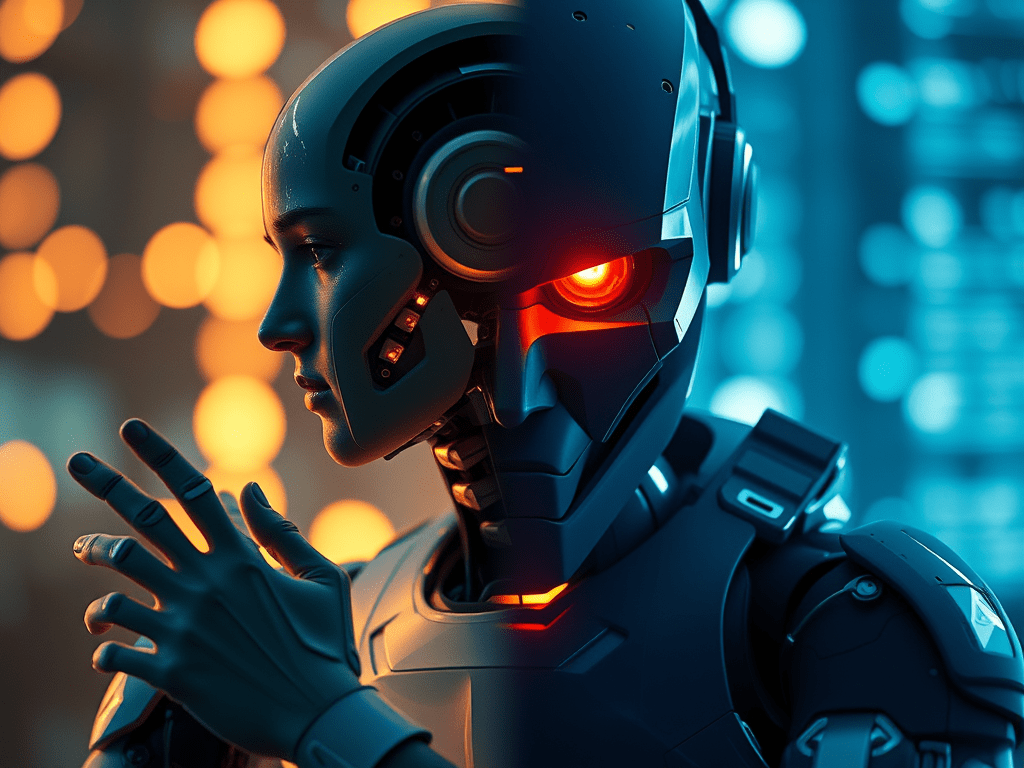
80年前阿西莫夫关于机器人三定律的思考,现在回头看,其实是对于机器人伦理的初步研究。因为三定律约束的是机器人的思想,进而约束机器人的行为。
时至今日,AI 正在迅猛发展,我们可以把机器人定律扩大为AI的伦理问题。查阅了一些专业的研究材料,总结出有如下研究结果:
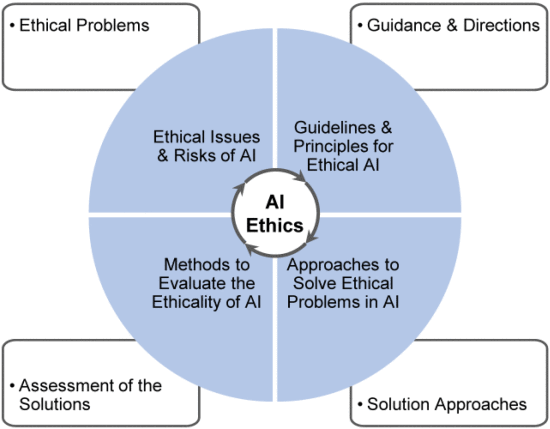
- Categorization Based on Problems, Guidelines, Approaches and Assessments.(Reference 1)
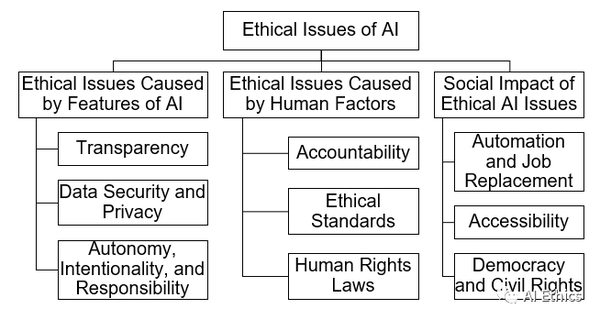
- Categorization Based on Features of AI, Human Factors and Social Impact.(Reference 2)
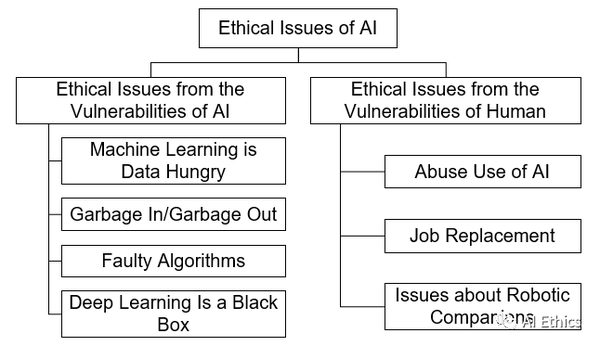
- Categorization Based on Vulnerabilities of AI and Human.(Reference 3)
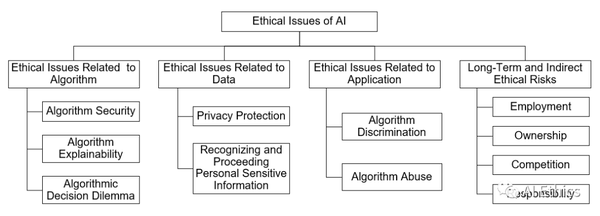
- Categorization Based on Algorithm, Data, Application, and Long-Term and Indirect Ethical Risks.(Reference 4)
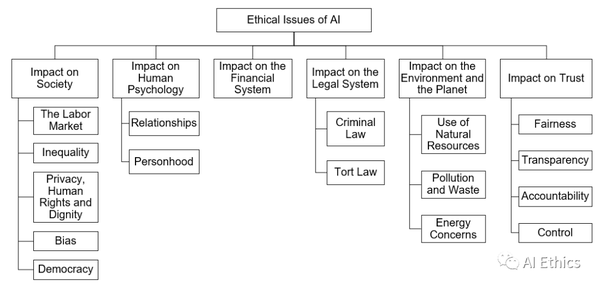
- Categorization Based on the Deployment of AI.(Reference 5)
我阅读了这些文章,理解了这些专业的研究结果的大体思想,虽然并不能完全理解这些研究的内容。但是,我认为,当AI 发展到一定阶段,AI伦理学将成为AI 发展的瓶颈或者说天花板,伦理学要为AI 技术划出伦理边界,有了这个边界,AI才不会作恶,就像核聚变的磁场约束了高温等离子体的有序燃烧,才不能发生核灾难。
学习《三体》中的叶文洁,我也做个大胆的推测,AI 伦理学有两个公理:公理一,AI来自人类的发明,AI 是人类群体最高智慧结晶,但是又不可能超越人类群体的最高智慧;公理二,AI可以超越人类个人,任何个人。所以如何确保AI作为先进生产力为人类服务,而不是伤害人类,应该是AI伦理学的核心内容。思考到这里,我发现我还需要学习更多的AI知识,哲学思想,物理学原理,才能在这个话题上进行更深入的思考。所以,这个话题先讨论到此,等我将来的知识储备更丰富了,再回来研究这个话题。
最后,衷心感谢南方科技大学的Changwu Huang, Zeqi Zhang, Bifei Mao and Xin Yao老师,我上边的材料引用了他们的研究成果。
Reference list:
- Changwu Huang, Zeqi Zhang, Bifei Mao and Xin Yao, “An Overview of Artificial Intelligence Ethics,” in IEEE Transactions on Artificial Intelligence (Early Access), 2022, doi: 10.1109/TAI.2022.3194503.
- K.Siau and W. Wang, “Artificial intelligence (AI) ethics”, J. Database Manage., vol. 31, no. 2, pp. 74-87, 2020.
- Ethics of Artificial Intelligence, New York, NY, USA:Oxford Univ. Press, 2020.
- “Artificial intelligence ethical risk analysis report”, Apr. 2022, [online] Available: http://www.cesi.cn/201904/5036.html.
- E. Bird, J. Fox-Skelly, N. Jenner, R. Larbey, E. Weitkamp and A. Winfield, “The ethics of artificial intelligence: Issues and initiatives”, Apr. 2020, [online] Available: https://www.europarl.europa.eu/thinktank/en/document/EPRS_STU(2020)634452.


 Teenage Philosopher
留下评论