
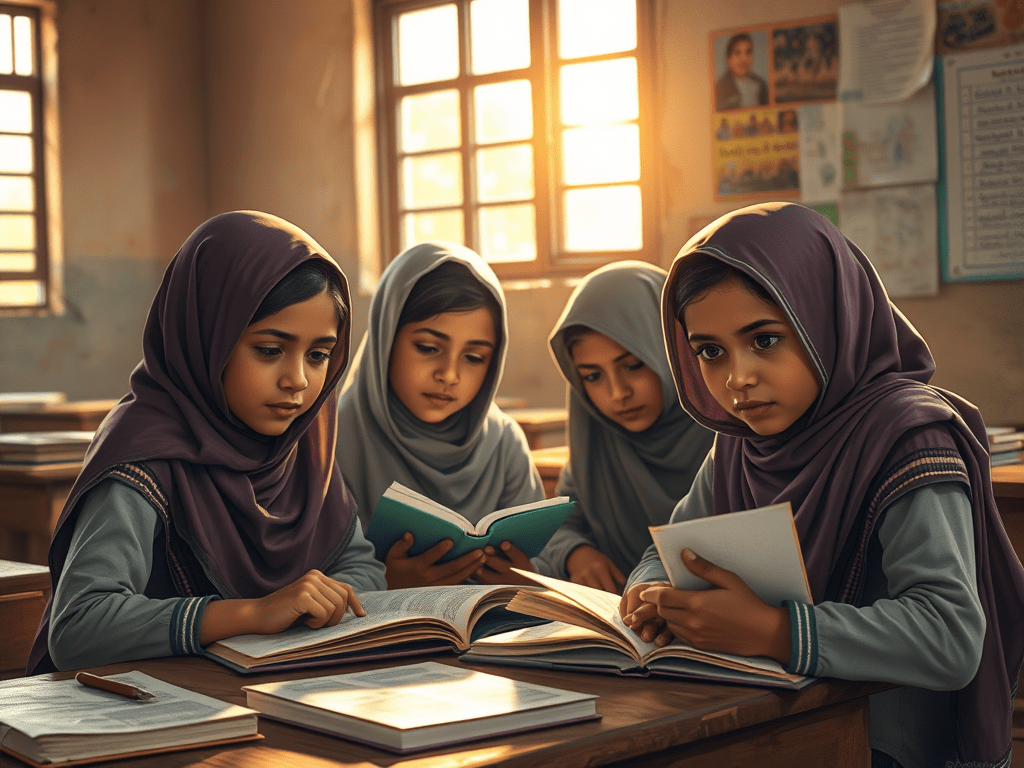
The Stark Reality of Gender Disparities in Education
The positive move towards gender equality and equal education is back on track! That is, unless one is a woman in an emerging economy.
Over the past generations, great progress for reaching gender equalities and increasing educational opportunities for women has been made. However, this improvement is does not mean global equality for women in all nations, but rather is a striking contrast towards the harsh circumstances faced by women and girls in the less wealthy countries, especially in rural areas. Though much of female education and equality, have greatly advanced, many women and girls remain to struggle in the cycle of poverty and limited educational opportunities which was enlarged by the COVID-19 pandemic.
In developed countries like the United States, women have increasingly become a formidable presence in the college-educated labor force. By the time of 2019, the percentage of women in this demographic has increased to the majority of 50.7%. This implies the closing of gender gap in education and employment, bringing long-term effects towards growth in economic and stability in overall society. But, the gender gap in low-income countries is not closing, it is in fact, expanding.
COVID-19: A Catalyst for Widening Educational Gaps
In contrast with the recovery after Covid-19 in richer areas, the influence of the pandemic in less wealthy areas has been far more negative, leaving emerging economies in a dire situation. The effect starts with the serious disruption exerted on educational systems, and data has shown an estimation of 11 million girls are at risk of hindered from returning to school. This disruption threatens to reverse decades of progress towards gender equality in education, letting pre-existing barriers to girls’ education in low-paid countries be exacerbated. As an example, over 80% of low-income girls in Guinea, Mali, and Pakistan had less than two years of schooling compared with those in similar conditions before the pandemic.
With the downturn of global economy, the broadening risk of poverty is also threatening the access to education in many low-income areas. Recent details in an investigation of women in sub-Saharan Africa has showed some women faring worse during COVID than men as the rural‑urban divide deepens and income falls, where the economic fallout is not only affecting women’s income, but also severly harming girl’s learning. The International Labor Organization noted that 81% of female workers in this region were already at risk of poverty in 2019, a figure made worse by the pandemic. In many more conservative cultures, the loss of income has forced many families to prioritize boys’ education over girls’, leading to increased dropout rates for girls. Statistics from Kenya showed that 16% of the girls didn’t return to school after the pandemic, far more than the amount of boys who did not return to schooling.
Understanding the reasons and the significance of the issue for humanity.
With the explanation of events given above, a variety of contributing factors can be identified. Economic instability, cultural norms, and inadequate infrastructure are playing essential roles. Furthermore, data selections and gathering in rural regions is often not reliable, leading to difficulty of effective policy formulation and resource distribution. In 2020, American published a set of differential privacy policy, causing the exact data mining to a more complicated phase, meaning the existence of far more large variation compared to it was reported, the point being more data precision is key.
Strategies for Change
To address this, several strategies can be implemented:
1. Strengthening Data Collection and Analysis: Improving the quality and accuracy of data collection in rural and less wealthy areas is critical. Reliable data enables the development of targeted interventions and effective policy-making.
2. Enhancing Social Service Delivery: Investing inclusive social service systems like subsidized childcare, which is a win-win for both women and economies, especially at lower economic classes.
3. Globally enhancing and investing in education, such as how in Senegal, life-cycle model simulations suggest that investing sufficiently in education to close gender gaps at each income level by almost 9%, while reducing poverty by more than 10%, and considering how not doing so could make many emerging countries lose billions every year.
4. Making sure that policies reflect the significant role that women often have in their homes and communities and the impact that has on future generations, key to economic benefits and developing and future generations.
There are many more potential solutions, but the first step to closing the gender gap globally, is to recognize women’s inequality as a global challenge the international community must be made aware of, and how it is one linked to not just the future of emerging economies, but humanity itself, and whether this will be recognized remains to be seen.

 Teenage Philosopher
留下评论