
Introduction
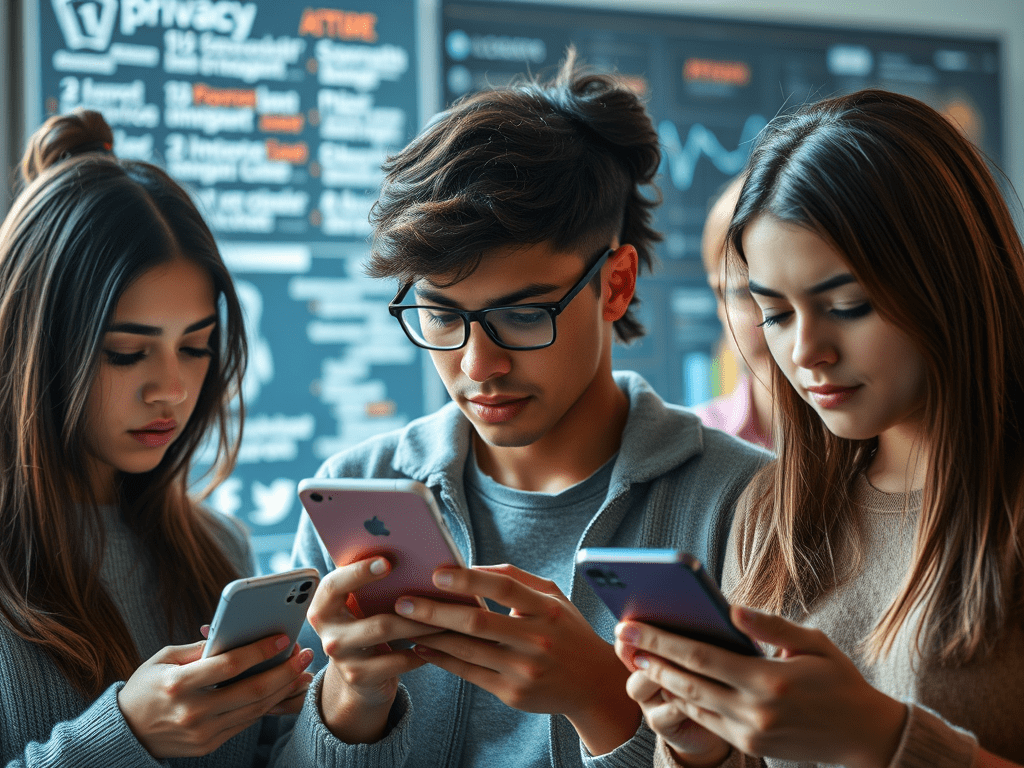
In our world dominated by globalized online platforms, our actions on the internet have been associated with a mass-scale redefinition of the boundaries of personal privacy. For teens in the U.S., seemingly mundane activities like sharing selfies, texting messages, and shopping on websites like Amazon have resulted in unintended data disclosure. As ubiquitous as this breach of privacy may seem, the teens who have been affected by it report having little control over the situation. According to a recent study, over 80% of teenage internet users in the U.S. are concerned about how their data is utilized, yet only 51% feel confident of their understanding of the actual processes of data collection (Surfshark, 2024). This fear generated by data leakage has therefore led to a general sense of insecurity of where exactly is their data going. For teenagers, who often lack the experience to make sound judgement, the psychological consequences of such redefinition of privacy—including anxiety, stress, and cyberbullying—can be severe. This paper aims to explore the emotional, cognitive, and behavioural effects of data privacy concerns on US teenagers, incorporate relevant theories, and discuss potential solutions, thereby providing a comprehensive analysis of the issue surrounding the disclosure of teenagers’ data privacy.
The Psychological Risks and Benefits by Group
Since the invention of social media, the relationship between teenagers and these platforms has been extensively researched, with ongoing discussions about their benefits. One major advantage is social connection. According to the research conducted by Jamieson et al. (2009), since strengthening friendships and forming new social groups play a critical role in the self-image of adolescents, social media can enhance the social capital they need by reinforcing existing relationships and facilitating new connections. Additionally, Torres (2024) has found that through providing a platform for self-expression and creativity, applications like Tik-tok and Instagram have enabled teens to explore their identities and present themselves to others. In both ways, social media has provided a good environment with sufficient opportunities for teenagers to connect with their peers and navigate their own lives, thereby providing much needed help along the winding path of their identity formation.
However, while sharing information on social media offers benefits, these benefits do not in some way even out or justify the significant risks that warrant further discussion and, ultimately, intervention. One of the most prevalent negative effects is anxiety and depression caused by social comparison. As teenagers spend more time on social media, they display an increasing tendency to compare themselves to their peers’ curated and often unrealistic portrayals, both consciously and unconsciously. Twenge et al. (2018) linked excessive Instagram use to rising rates of depression and body image issues among teenagers. Ehmke(2024) from the University of Chicago indicates anxiety and depression are linked to excessive social media use, with different factors including decreased direct communication and obsessive focus on one’s own image. Although teenagers may not explicitly admit it, they are affected by online influencers and may feel pressured to emulate their behaviors to gain acceptance. Prolonged comparisons can erode self-confidence, potentially leading to depression and anxiety.
Another glaring downside of this internet use is the rampant cyberbullying on social media platforms. Cyberbullying can occur anywhere and disproportionately affects teenagers who may not be prepared for their privacy being weaponized against them. Kowalski et al. (2014) found a significant association between cyberbullying exposure and mental health struggles in adolescents. Additionally, the realization that their privacy has been invaded leads to feelings of vulnerability and intrusiveness. Despite these drawbacks many teenagers take minimal action to protect their privacy (Segijn&Opree, 2022).
Theoretical Framework
Some theories could be used to explain the motivation behind the actions and the dilemma of U.S. teenage internet users, and serve as a foundation for providing theory-based solutions. Sharing preferences of different topics is the most common type of privacy disclosure, where teenagers post their opinions and taste on social media for explicit purpose peer validation, and thereby inadvertently allow online feedback to define them. Valkenburg and Peter (2011) found that adolescents rely on social media interactions to form their self-concept and receive social acceptance. Their essential motivation of seeking positive social identity by religiously following in-group inflections can be understood through the Social Identity Theory (Turner&Oakes, 1986). Based on this theory, the fast-flowing and changing trends of online media make different individuals conform to what is known as “low-penetration group characteristics,” i.e., whether low-status members in the groups can easily transform themselves into members of high status through displaying a positive distinctiveness that is both unique and conforming to the values of the group. As time goes on, members of these groups need to devote increasing amounts of time to search for positive distinctiveness, and where positive distinctiveness becomes precious enough to be trading a certain degree of privacy with.
While unconsciously providing personal information occupies an important proportion of privacy disclosure, deliberately provided private information plays an even bigger role. The theory of privacy paradox is provided as a reasonable explanation. “Although survey results show that the privacy of their personal data is an important issue for online users worldwide, most users rarely make an effort to protect this data actively and often even give it away voluntarily,” wrote Gerber et al. (2018) in explanation of this puzzle. This explanation accurately tells the action of a related phenomenon, where social media users neglect basic measurements of protecting their own personal devices for the sake of convenience. In their 2023 research, Zulfahmi et al. discovered that apps like Facebook and Whatsapp are hotspots where hackers will take advantage of the basic information users casually share about themselves (such as birth dates and locations) to commit identity theft and a string of other crimes.
Solutions
The pervasive use of social media among US teenagers has brought both psychological benefits and significant risks related to data privacy. Based on the above mentioned theory, several solutions can be proposed. First, promoting digital literacy is fundamental to addressing the psychological effects of social media on teenagers. Research by Valle et al. (2024) identifies three components of a privacy framework: inquiry, reflection, and action, highlighting the importance of educating online users about how their behaviors affect themselves and their communities. Enhancing the general sense of responsibility among online users can reduce cyberbullying and improve security awareness, especially in an era where digital data collection is ubiquitous. Therefore, educating all generations about privacy settings, recognizing scamming attempts, and managing digital footprints can establish a foundational level of privacy security.
Another possible solution is the development of tools and platforms that mitigate anxiety, depression, and FOMO (Fear of Missing Out). According to the FOMO theory, the anxiety and depression induced by social media stem from the oversharing of personal experiences, making it challenging to balance social needs with privacy security awareness (Przybylski et al., 2013). The prevalence of FOMO among teeangers who use social media calls for concrete actions, and research published by Akbari et al. (2021) has highlighted the potential benefits of mental therapy, where peer support and frequent social contact work together to help teens rehabilitate from FOMO. Establishing online platforms with positive incentives could help, and some initiatives have already shown success. This suggests that it is possible to derive more benefits from social media while minimizing negative effects.
Last but not least, fostering a culture of thoughtful and intentional sharing on social media could serve as one more effective solution. Kim and Drumwright (2016) suggest that value-driven content enhances user engagement and well-being. By having clear personal goals, users can more easily achieve a sense of belonging without compromising their privacy, leading to more meaningful and secure online interactions.
In conclusion, to address the issues, implementation of digital literacy programs teaching privacy settings and cybersecurity in schools, development of platforms with mental health tools, and encouragement of intentional sharing by promoting value-driven content are suggested. These initiatives foster responsibility and enhance well-being, while balancing online engagement and privacy.
Reference List
Akbari, M., Ljungberg, J., & Nordin, M. (2022). Gaming motivations and gaming disorder symptoms: A systematic review and meta-analysis. Journal of Behavioral Addictions, 11(3), 667–688. https://doi.org/10.1556/2006.2022.00053
Ehmke, R. (2024, May 24). How using social media affects teenagers. Child Mind Institute. https://childmind.org/article/how-using-social-media-affects-teenagers/#lowering-the-risks
Gerber, N., Gerber, P., & Volkamer, M. (2018). Explaining the privacy paradox: A systematic review of literature investigating privacy attitude and behavior. Computers & Security, 77, 226–244. https://doi.org/10.1016/j.cose.2018.04.002
How people see their privacy in 2022 – Surfshark. (2024, June 10). Surfshark. https://surfshark.com/attitude-on-privacy
Kim, E., & Drumwright, M. (2016). Engaging consumers and building relationships in social media: How social relatedness influences intrinsic vs. extrinsic consumer motivation. Computers in Human Behavior, 63, 970–979. https://doi.org/10.1016/j.chb.2016.06.025
Łosiak-Pilch, J., Grygiel, P., Ostafińska-Molik, B., & Wysocka, E. (2022). Cyberbullying and its protective and risk factors among Polish adolescents. Current Issues in Personality Psychology. https://doi.org/10.5114/cipp.2021.111404
Naslund, J. A., Bondre, A., Torous, J., & Aschbrenner, K. A. (2020b). Social media and mental health: Benefits, risks, and opportunities for research and practice. Journal of Technology in Behavioral Science, 5(3), 245–257. https://doi.org/10.1007/s41347-020-00134-x
Norberg, P. A., Horne, D. R., & Horne, D. A. (2007). The privacy paradox: Personal information disclosure intentions versus behaviors. Journal of Consumer Affairs, 41(1), 100–126. https://doi.org/10.1111/j.1745-6606.2006.00070.x
Przybylski, A. K., & Murayama, K. (2013). Motivational, emotional, and behavioral correlates of video game play. Journal of Personality and Social Psychology, 105(4), 276–293. https://doi.org/10.1037/a0032132
Pérez-Torres, V. (2024). Social media: A digital social mirror for identity development during adolescence. Current Psychology. https://doi.org/10.1007/s12144-024-05980-z
Romer, D., Jamieson, K. H., & Pasek, J. (2009). Building social capital in young people: The role of mass media and life outlook. Political Communication, 26(1), 65–83. https://doi.org/10.1080/10584600802622878
Savitz, E. (2012, March 6). The growing problem of privacy-invading mobile apps. Forbes. https://www.forbes.com/sites/ciocentral/2012/02/23/the-growing-problem-of-privacy-invading-mobile-apps/
Turner, J. C., & Oakes, P. J. (1986). The significance of the social identity concept for social psychology with reference to individualism, interactionism, and social influence. British Journal of Social Psychology, 25(3), 237–252. https://doi.org/10.1111/j.2044-8309.1986.tb00732.x
Valle, M., Okimoto, H., Glover, M., Li, T., & Lee, C. (2024). Technology and adolescent development: A critical review of the digital youth literature. Review of Educational Research, 94(1), 3–36. https://doi.org/10.3102/00346543241247224
Van Ooijen, I., Segijn, C. M., & Opree, S. J. (2022). Privacy cynicism and its role in privacy decision-making. Communication Research, 51(2), 146–177. https://doi.org/10.1177/00936502211060984
Zulfahmi, Z., Rahim, A. R. A., & Sulaiman, N. (2022). A review on the application of artificial intelligence in dentistry. Procedia Computer Science, 216, 1094–1101. https://doi.org/10.1016/j.procs.2022.12.205
 Teenage Philosopher
留下评论