
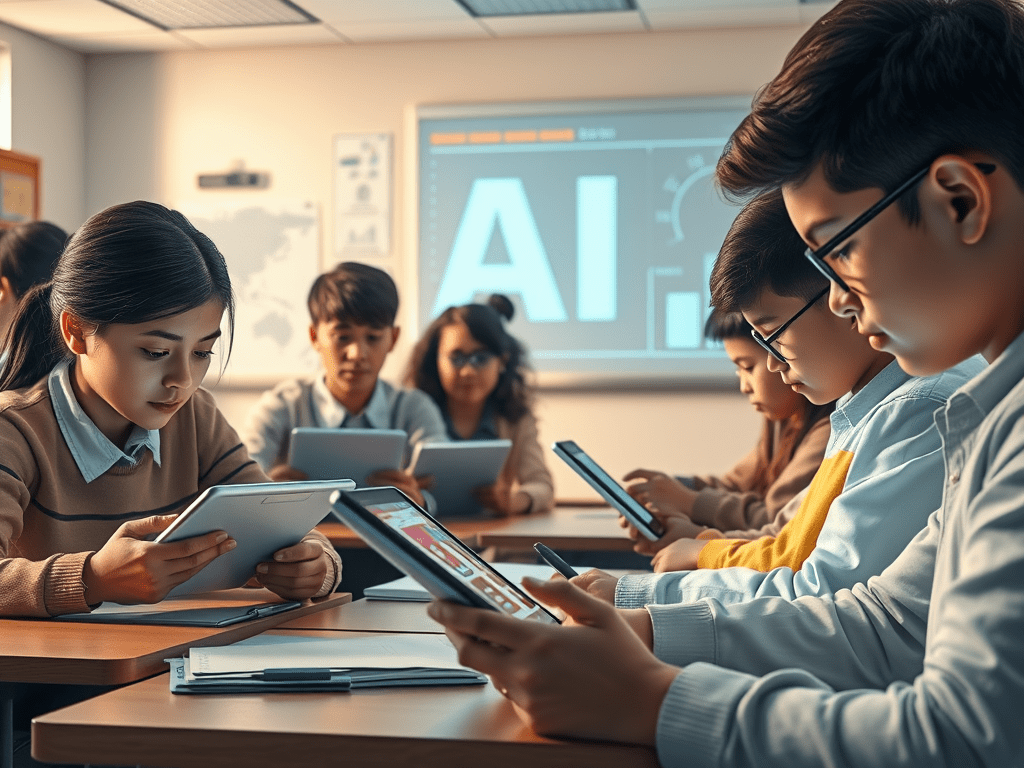
Metacognitive ability, which refers to the capacity to reflect on one’s own thought processes, typically includes formulating learning plans, monitoring processes, and evaluating strategies. Students’ metacognitive abilities likely influence academic achievement and thinking patterns, yet they are often still developing during the high school years. Multiple developmental studies investigating self-reported use of metacognitive learning strategies among high school students have shown no significant developmental increase, highlighting the need for corresponding metacognitive education(Leutwyler, 2009). Beyond students’ own incomplete development of metacognitive abilities, incorrect use of AI itself can further diminish these abilities. Research published in the International Journal of Innovative Science and Research Technology indicates that “AI supports learning assistance and self-regulation development, but over-dependence on it results in lower problem-solving skills and decreased metacognitive thinking”(Goyal, 2025). Therefore, considering the increasingly widespread use of AI among students and the unstoppable trend of AI integration, schools, particularly high schools, should not expect to control student AI usage solely through strict regulations. Instead, they should teach students how to use AI correctly. However, according to HEPI data, only a third (36%) of students have received training in AI skills from their institution(Student Generative AI Survey 2025 – HEPI, 2025).
The rationale for integrating AI into education rather than eradicating it lies not only in potential harms but also in the potential opportunity to enhance students’ metacognitive abilities. Yuan and Hu (2024)link generative artificial intelligence with the cultivation of reflective skills, leveraging AI’s strong extensibility and capacity for individualization to powerfully demonstrate that generative AI can provide effective support for students’ reflective practice. In another study exploring how to integrate AI into modern learning, AI, through real-time monitoring and feedback on the learning process, can act as a “cognitive partner” for learners, fostering Meta-AI skills (specialized metacognitive competencies for engaging AI as a cognitive partner) while assisting students in achieving more efficient learning in areas such as information retrieval, idea generation, and language polishing(Levin et al., 2025). Furthermore, in supporting students’ Self-Regulated Learning (SRL), features such as adaptive learning paths, immediate feedback, and learning log generation provided by AI can serve as externalized cognitive scaffolds, making students’ thinking processes visible and thereby gradually internalizing them into self-regulatory and metacognitive abilities (Banihashem et al., 2025). Consequently, whether considering the positive or negative effects of AI, instructors should design AI-assisted courses to support students’ metacognitive abilities, thereby enhancing academic performance.
On one hand, students exhibit vulnerabilities in using AI and screening information; insufficient metacognitive ability during AI use leads to more harm than benefit. On the other hand, the traditional role of the teacher as a knowledge transmitter is becoming less effective: the way students use AI is encroaching upon the traditional teacher’s role, requiring teachers to transform their role in teaching, participating as users of AI rather than competitors. Falebita (2024), analyzing technostress models, mentions that for many teachers, their perceived usefulness and ease of use of AI lead to their low intention of integrating AI into classroom instruction. On the other hand, when exploring teachers’ artificial intelligence awareness, researchers suggest that concerns about AI’s ethical and security aspects and uncertainties regarding how to effectively implement AI in education can cause teachers to be hesitant about using this technology(Nazaretsky, 2021). Exept perspectives from technology, teachers are concerned about potential job displacement, fearing that AI may weaken their professional duties(Medina et al., 2024). Some teachers even expect AI to be absolutely correct even in situations where absolute truth may not exist (e.g., grading open-ended questions). Regardless, a series of concerns encompassing academic integrity, originality, and technology have led some teachers to develop a negative bias against using AI. However, this only deprives students of opportunities to practice using AI and to enhance their metacognitive abilities through AI, without bridging the gap between the new teacher roles and the previous teacher roles in the context of increasing AI use (e.g., the gap between student-centered classrooms and traditional authoritative teachers). It is worth mentioning that, whether considering the probability of teachers being replaced in the AI era (the automation probability for primary school teachers, middle school teachers, and university teachers is only 0.44%, 0.78%, and 0.32% respectively(Frey & Osborne, 2016) or discussions among researchers regarding teaching strategies, evidence suggests that the teacher’s role is not being marginalized. In fact, with the emergence of AI, the teacher’s role is undergoing profound transformation within the current context of teaching strategies(Gentile et al., 2023). Connecting back to the previous points, teaching students how to use AI can effectively enhance their metacognitive abilities, improve their skills in planning and reflection, and enable more comprehensive and effective use of AI. Simply banning student AI use outright cannot break the existing trend of AI proliferation. Teachers should provide students with correct and effective methods for using AI and develop teaching plans, content, and objectives from a new perspective.
However, whether the focus of teachers’ instructional practices on teaching objectives sufficiently aligns with students’ actual needs requires more data collection and represents a gap area that my research will aim to address through data collection. To validate the reasonableness of this perspective with real-world data and to more broadly supplement the existing gap between teacher roles and student perspectives on learning needs, this study primarily focuses on understanding the current state of the help teachers provide to students (knowledge transmission) within the educational context of my school/city, the current state of student AI usage, and the current state of student demand for teacher support (e.g., metacognitive ability enhancement). This will thereby supplement or refine the identified mismatches between the “help provided by teachers” and the “actual needs of students,” forming a basis for providing teaching suggestions and improving instructional course design.
Reference List
Ayeni, N. O. O., Hamad, N. N. M. A., Chisom, N. O. N., Osawaru, N. B., & Adewusi, N. O. E. (2024). AI in education: A review of personalized learning and educational technology. GSC Advanced Research and Reviews, 18(2), 261–271. https://doi.org/10.30574/gscarr.2024.18.2.0062
Bahroun, Z., Anane, C., Ahmed, V., & Zacca, A. (2023). Transforming Education: A Comprehensive Review of Generative Artificial Intelligence in Educational Settings through Bibliometric and Content Analysis. Sustainability, 15(17), 12983. https://doi.org/10.3390/su151712983
Banihashem, S. K., Bond, M., Bergdahl, N., Khosravi, H., & Noroozi, O. (2025). A systematic mapping review at the intersection of artificial intelligence and self-regulated learning. International Journal of Educational Technology in Higher Education, 22(1). https://doi.org/10.1186/s41239-025-00548-8
Falebita, O. S. (2024). Assessing the relationship between anxiety and the adoption of Artificial Intelligence tools among mathematics preservice teachers. Interdisciplinary Journal of Education Research, 6, 1–13. https://doi.org/10.38140/ijer-2024.vol6.20
Frey, C. B., & Osborne, M. A. (2016). The future of employment: How susceptible are jobs to computerisation? Technological Forecasting and Social Change, 114, 254–280. https://doi.org/10.1016/j.techfore.2016.08.019
Gentile, M., Città, G., Perna, S., & Allegra, M. (2023). Do we still need teachers? Navigating the paradigm shift of the teacher’s role in the AI era. Frontiers in Education, 8. https://doi.org/10.3389/feduc.2023.1161777
Gerstung-Jungherr, Valeska & Deuer, Ernst. (2025). Künstliche Intelligenz im dualen Studium: Eine vergleichende Analyse der Perspektiven und Praktiken von Stakeholdern des dualen Studiums.
Goyal, A. (2025). AI as a Cognitive partner: A systematic review of the influence of AI on metacognition and Self-Reflection in critical thinking. International Journal of Innovative Science and Research Technology, 1231–1238. https://doi.org/10.38124/ijisrt/25mar1427
Leutwyler, B. (2009). Metacognitive learning strategies: differential development patterns in high school. Metacognition and Learning, 4(2), 111–123. https://doi.org/10.1007/s11409-009-9037-5
Levin, I., Marom, M., & Kojukhov, A. (2025). Rethinking AI in Education: Highlighting the metacognitive challenge. BRAIN BROAD RESEARCH IN ARTIFICIAL INTELLIGENCE AND NEUROSCIENCE, 16(1, Sup. 1), 250–263. https://doi.org/10.70594/brain/16.s1/21
Medina, M., Mejia, R. A., Mejes, D. M., & Bustamante, M. (2024). Self-Reported Preparedness and Factors Influencing AI Tools integration in teaching among Master’s degree students in a selected Teachers Education College. International Journal for Multidisciplinary Research, 6(1). https://doi.org/10.36948/ijfmr.2024.v06i01.12894
Mononen, A. (2025). Forecasted self: learning 21st-century digital skills with artificial intelligence and real-life projects. https://urn.fi/URN:ISBN:978-951-25-3507-1
Savelka, J., Agarwal, A., An, M., Bogart, C., & Sakr, M. (2023). Thrilled by Your Progress! Large Language Models (GPT-4) No Longer Struggle to Pass Assessments in Higher Education Programming Courses. ICER ’23: Proceedings of the 2023 ACM Conference on International Computing Education Research – Volume 1, 78–92. https://doi.org/10.1145/3568813.3600142
Spirgi, L., & Seufert, S. (2025). GenAI as a Learning Assistant, an empirical study in higher education. 17th International Conference on Computer Supported Education, 27–34. https://doi.org/10.5220/0013199300003932
Student Generative AI Survey 2025 – HEPI. (2025, August 27). HEPI. https://www.hepi.ac.uk/reports/student-generative-ai-survey-2025/
Yuan, B., & Hu, J. (2024, November 19). Generative AI as a tool for enhancing reflective learning in students. arXiv.org. https://arxiv.org/abs/2412.02603
(the end)

 Teenage Philosopher
留下评论